Crafting Experiences That Matter
Design is a strategy problem first and a craft problem second. Both have to be excellent. My process is the system that connects them, blending business strategy, customer research, AI fluency, and team craft into work that ships and works.
The goal is simple: better decisions, faster, with the customer at the center of every one.
The Journey
Discover & Define
Strategy and vision
Before we design anything, we decide where to play and how to win. I use the Where to Play and How to Win framework, lean canvas, and customer lifecycle mapping to align teams around the unique value proposition and the unfair competitive advantage we're building toward. This is where I partner most closely with the executive team, Product Management, and Engineering to align design outcomes with the broader business.
Discover and define

The questions that matter most are the ones we ask before we have answers. I lead user research, customer journey mapping, competitive analysis, and cross-functional brainstorming to find the biggest opportunity in the customer lifecycle. We look for the moments where ambiguity, friction, or risk is highest, and we focus there. The lean canvas helps us validate assumptions about users, value, and metrics before the team commits to the build.
Prioritize and plan
Doing everything at once is the surest way to do nothing well. I use faceted feature analysis to bring three perspectives to the same table at the same time. UX rates user value. Product assesses business impact. Engineering evaluates feasibility. Everyone's expertise lives in the score, so the priority list is one the team actually owns.
Design and validate
This is where we sketch, prototype, and test our way from idea to evidence. Design Sprints, rapid prototyping, and continuous user research keep us learning fast and shipping smart. I bring UX heuristics, information architecture, and platform-aware thinking to every room. I also bring AI-assisted ideation, research synthesis, and pattern detection where it helps the team cover more ground without losing rigor. The standard for the work: every interaction has to be useful, valuable, differentiated, and once in a while surprisingly delightful.
Build and ship
Engineers are partners from day one. I write clear user stories with acceptance criteria, embed researchers in the team, and build the rituals that keep design, product, and engineering aligned through implementation. Clarity here saves rework later, and rework is the most expensive design tax there is.
Measure and iterate
Launch is a beginning. We measure with qualitative and quantitative data, identify what's working and what isn't, and feed those insights back into the next sprint. Outcomes cascade from problems, so we treat both as real and trackable.
First things first: we need to know what we're solving. I dive deep into user research, competitive analysis, and cross-functional brainstorming. We're not just asking "what" - we're asking "why". A lean canvas helps us nail down users, value props, and key metrics. It's all about validating our assumptions before we go too far down the rabbit hole.
Why It Works
Tested across industries and stakes that matter:
At Ford, this approach guided an AI-powered customer knowledge base that lifted home charging confidence 74% and public charging confidence 79%.
At Philosophie, it scaled a global delivery team that took client NPS from 7.5 to 9.0 and grew project revenue from $6.3M to $8.7M.
At Tradesy, AI image analysis grew product listings 15% and supply 10%.
At eHarmony, resequencing the relationship questionnaire lifted completion 23%.
At Farmers Insurance with RPA, the Silver Effie-winning Unbelievable Claims campaign drove 3.4 million site visits and lifted initiated quotes 127%.
What this approach delivers
Products customers actually use and businesses actually invest in.
Decisions grounded in data and customer evidence.
Cross-functional collaboration that produces work nobody could ship alone.
Experiences that stand out in crowded markets because they treat trust as a measurable outcome.
Design Process Examples
The work below is the artifacts behind the process. Pieces are redacted or generalized to respect client confidentiality.
eHarmony User Journey
Embarking on a user journey takes investment. I illustrated the journey to help stakeholders see how users actually interacted with the site, which earned the buy-in to fund the qualitative and quantitative data work that followed.

User Flow Workshop
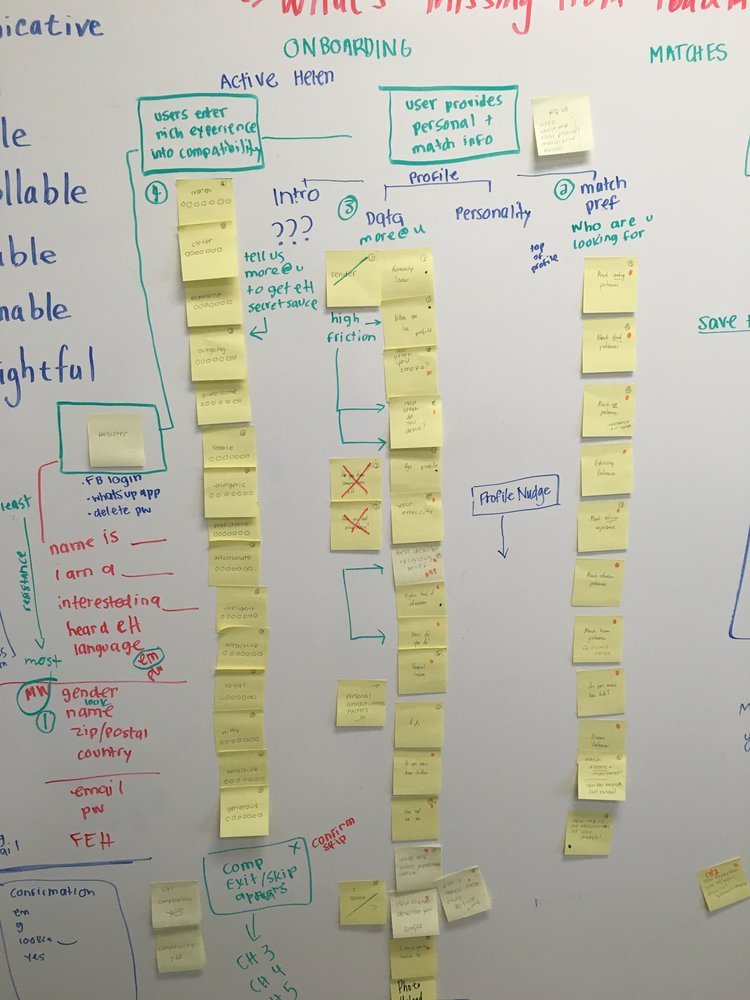
The messy creative work behind the onboarding flow workshop. We explored flow variations and prioritization across profile, match preferences, and the compatibility questionnaire.
eHarmony High-fidelity User Flow
This flow shows the strategic thinking for onboarding new users through the relationship questionnaire, conversion, and communication between matches. Counter to expectation, the interstitials did not increase drop-off and they helped underscore the importance of long-term relationship success.

Information Architecture
Information architecture is the core of user experience. It makes complexity clear by giving users an organized structure of the information they need. The examples below show learnable environments across iOS, Android, mobile web, and desktop, designed for a multi-device world.

eHarmony IA Cross-Platform Parity
Holistic vision creates peaceful simplicity. I designed IA across iOS, Android, mobile web, and desktop to surface the disparity between platforms, harmonize the taxonomy, and transform empty forward user paths into meaningful transitions.

eHarmony RQ (Relationship Questionnaire) A/B Test
With the goal of reducing user fatigue, I led an effort exploring sequence reorganization, question removal, and photo upload prioritization. The structure helped reimagine sections for match preferences, profile, and compatibility. Completion rate lifted 23%.
RESEARCH
Strong research starts with disciplined methodology. Product and UX teams have to agree on objectives, settle on a clear approach, and verify that every question delivers an answer that informs the design. I have extensive experience with moderated and unmoderated techniques to define customer needs, build data-driven personas, run task analysis, and improve user flows.

First Time Buyer Research
Conversion data showed we were struggling to retain first-time buyers. The team ran a design sprint, built a prototype, conducted user research, and learned that participants wanted more information about individual sellers. Sales count and seller ratings would have substantially increased trust and sell-through. Stakeholders wanted to build trust through the Tradesy brand. Users told us they wanted visibility into individual sellers. Naming the gap shifted the strategy.

Onboarding Experiment
The challenge was to reimagine an engaging experience that helps buyers find relevant products. We created onboarding that led users to the right products from reputable sellers and brought them back. The prototype showed that buyers don't mind giving detailed preference information when it improves recommendations. We also tested global preferences against session-specific preferences.

Competitive Analysis - Mitsubishi
A competitive analysis I led for a Saatchi and Saatchi project, identifying competitive usability gaps that helped inspire creative differentiation.
Heuristics
Heuristics get called old school. They're foundational. They establish the principles every team needs, and there are agile ways to fold them into design rationale without slowing the work.

IA Heuristics Checklist – Redesigned
Abby Covert, the IA expert and author of How to Make Sense of Any Mess, created a poster referencing five historical sources of IA and usability heuristics across ten core principles. Each principle came with a checklist of thought-starter questions for better critiques. I struggled to get teams to use the poster, so with Abby's permission I converted it into a Figma file designers could use as an active checklist during the work. Available on request.
Personas
The best personas come from data. I start with qualitative research, layer in quantitative cluster segmentation, and combine the two to understand attitudes, perceptions, and motivations. Analytics, demographics, social media behavior, and competitive analysis all play a part. Personas are how we model and communicate the humans we're designing for.

Tradesy Seller Persona
An early Seller persona representing a small qualitative data set. A starting point. I pivoted the approach to a more robust data-driven initiative, working closely with the BI team to build cluster-based segmentation analysis. We identified associated traits and common behaviors for LTV users, then evaluated those patterns against additional qualitative research to learn perceptions, attitudes, concerns, and motivations.